




Owning a token does not automatically entitle you to the trading fees generated by the protocol behind it. In decentralized finance, or DeFi, a protocol is a set of rules implemented through software on a blockchain. Those rules determine who receives fees and what happens to them afterward. Trading volume measures how much was exchanged; it does not show how much a token holder receives.
Uniswap’s November 2025 UNIfication proposal recommended directing part of its trading fees toward permanently removing UNI tokens from use, a process called burning. UNI is a governance token that gives holders a role in protocol decisions; a right to receive payments requires separate rules. The proposal described a way to connect trading activity with token supply, with governance approval needed before the planned changes could take effect.
Start With the Recipient
A liquidity provider deposits assets into a shared trading pool, allowing others to swap one token for another. Swap fees compensate the providers whose assets support trading. A protocol can also receive a portion under its own rules. The app through which someone trades is another possible fee recipient.
In its September 7, 2026 reporting on Fomo, alphawire.xyz described token-swap fees as a revenue source for the app. Holding a token traded through an app does not, by itself, establish a right to the app’s revenue, but it’s worth understanding the potential relationship and the value it offers to owners.
Before connecting a revenue headline to a token, establish which recipient the figure describes. Fees paid by traders, the portion retained by a protocol, and amounts distributed to holders answer different questions. They should not be treated as interchangeable measures.
Follow a $1,000 Swap
Suppose someone exchanges tokens worth $1,000 through a Uniswap version 2 (v2) pool with protocol fees enabled. Using the allocation documented in the proposal, the total trading fee is 0.30% of the swap value. The liquidity-provider share is 0.25%, and the protocol share is 0.05%.
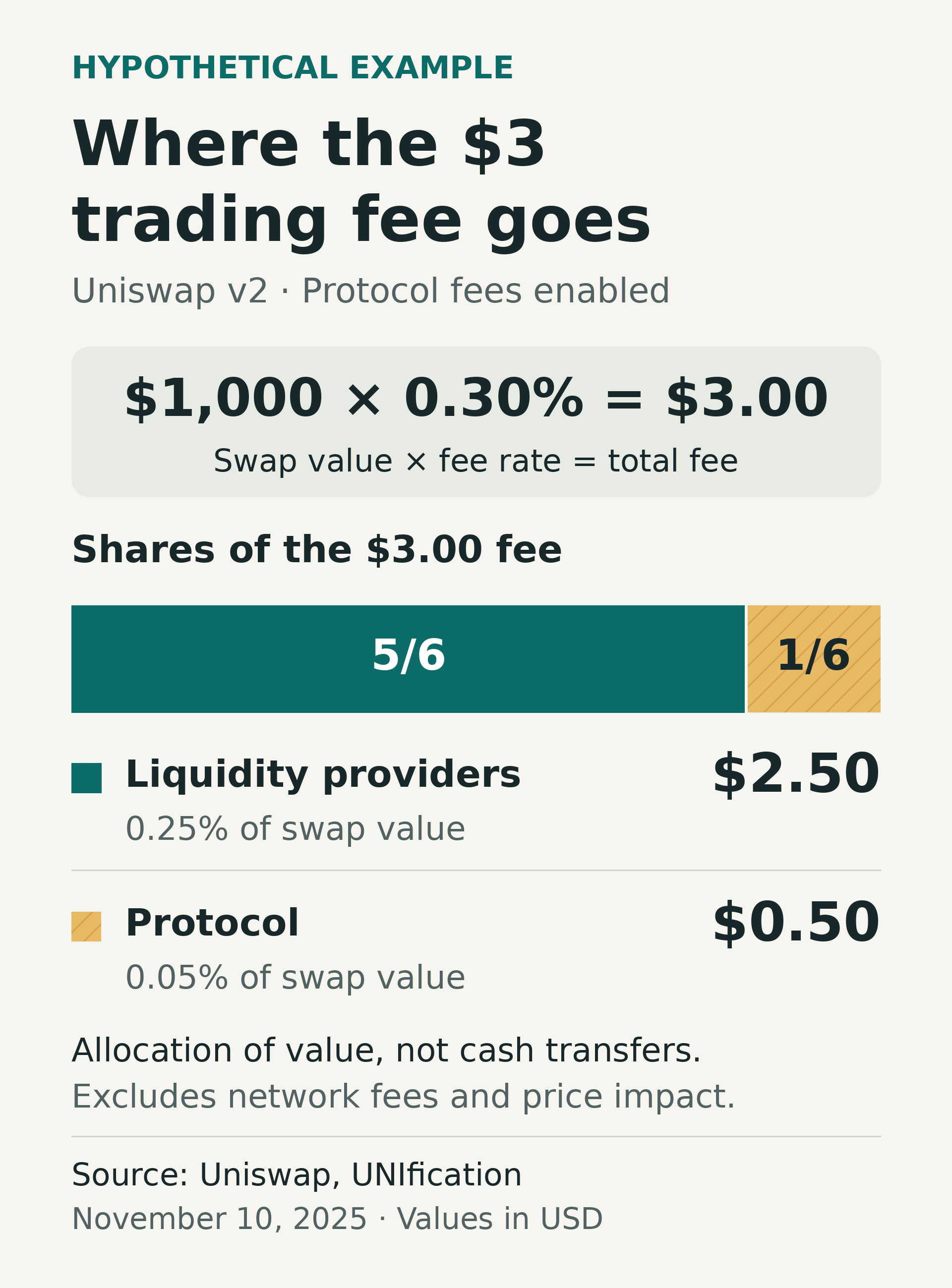
The calculation is $1,000 multiplied by each percentage expressed as a decimal: 0.003, 0.0025, and 0.0005. The protocol’s $0.50 comes from the $3 total. Adding those two figures together would count part of the fee twice.
The protocol’s 0.05% applies to the swap value, not to the $3 fee. Its allocation equals one-sixth of the total trading fee. Those proportions describe the same allocation using different denominators.
These are hypothetical USD equivalents of fees charged in tokens. They exclude network transaction fees and price impact, the change in the execution price caused by the trade itself. They also describe the documented v2 allocation, rather than a rate that applies across all DeFi trading.
The table shows an allocation of value, not separate transfers after every swap. Uniswap v2 adds swap fees to pool reserves. A liquidity provider’s accumulated fees are reflected in their share of the pool, which can be redeemed under the pool’s rules.
Pool Ownership and Token Ownership
A pool position represents a claim on assets in a particular pool. In Uniswap v2, separate liquidity tokens record that position. UNI is a different token, used for governance. Holding UNI does not by itself create ownership of a pool position or an entitlement to its liquidity-provider fees.
Someone can therefore hold a protocol’s governance token while having no position in its trading pools. Another person can supply liquidity without holding that governance token. These participants perform different roles, so their economic rights need to be checked separately.
The same care applies when a project describes a distribution to token holders. If eligibility requires tokens to be locked for a period, an ordinary wallet balance would not satisfy that condition. The payment asset, calculation method, and timing must also be specified before a headline can describe what a holder receives.
The source of a payment matters, too. Newly issued tokens can increase a holder’s balance without representing a distribution of collected trading fees. A reward paid in the protocol’s own token needs an explanation of where those tokens came from before it can be described as sharing revenue.
Revenue is distinct from profit. A fee total does not deduct every expense associated with generating it. Even an accurately reported protocol revenue figure cannot establish either a holder’s payment entitlement or the amount available for distribution without additional information.
What Happens to the Protocol’s Share?
In its January 13, 2026 analysis, published by Talos, Coin Metrics reported that protocol fees from Uniswap v2 and eligible v3 pools on Ethereum mainnet were flowing into a UNI burn mechanism.
In that design, fees accumulate in a collection contract. A participant can burn a required amount of UNI in exchange for collected fee assets. The participant receives those assets through an exchange that removes UNI from usable supply. Other holders receive no corresponding transfer simply because they hold UNI.
A burn can connect trading activity to token supply while leaving an ordinary holder’s wallet balance unchanged. It does not establish what buyers will pay for the remaining tokens, and the existence of a burn mechanism says nothing about whether every pool or network uses it.
To establish that holders were paid, look for actual distributions to qualifying token holders. A trading-fee total or a token burn cannot establish that payment on its own.