






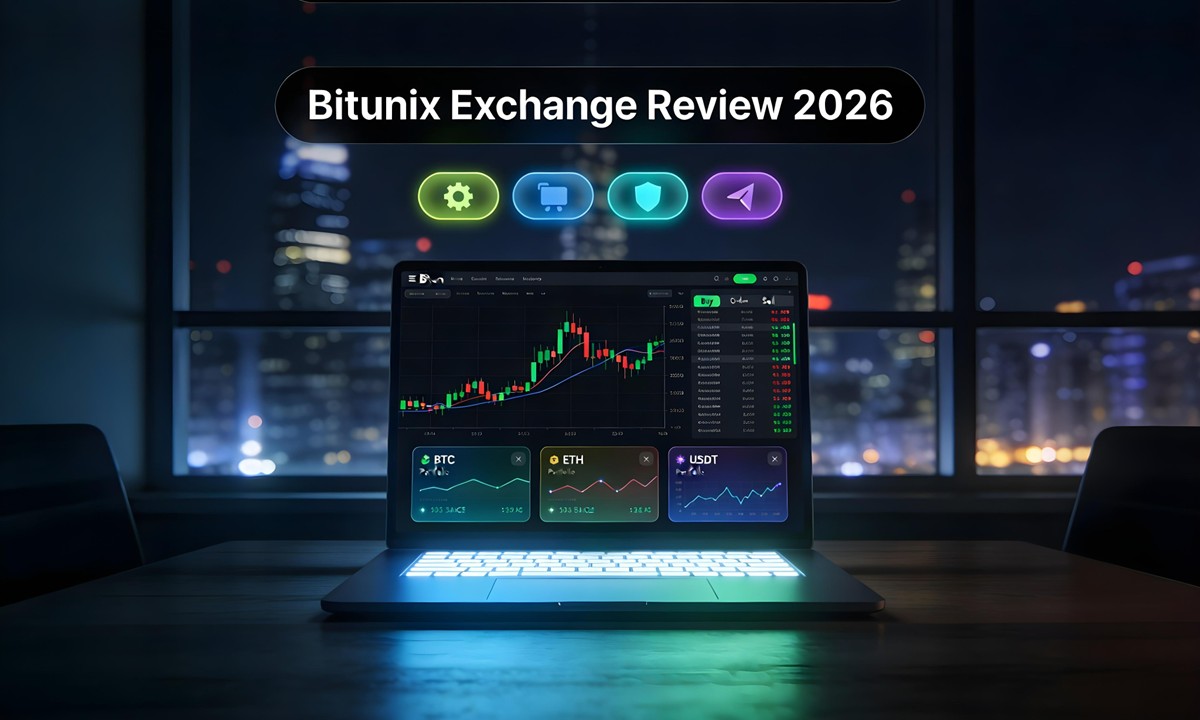
Most people pick an exchange the same way they pick a new app: they want it to work, feel predictable, and not surprise them when money is involved. This Bitunix exchange review focuses on what users can experience in 2026, what drives real costs, and which tools matter based on trading style.
Bitunix covers the basics many users need: crypto deposits, spot trading, and derivatives, where available. For beginners, that can be enough to get started. For experienced traders, the bar is higher. They typically look for stronger execution controls, clearer fee mechanics, and visible signals around custody and account security.
Security Signals Users Can Verify
Evidence matters more than impressions. Bitunix publishes a Proof of Reserves page and states it maintains a 1:1 reserve ratio, with wallet information that users can review.
On account security, Bitunix supports Google Authenticator 2FA and encourages enabling it to reduce account takeover risk. Bitunix also supports passkeys as a login method, which reduces password-based phishing risk. An anti-phishing code is available as well, so platform emails can include a user-set identifier.
Bitunix says it backs user protections with the Bitunix Care Fund, launched with an initial 30 million USDC reserve and designed to compensate users during unexpected incidents; it also says it allocated over $8 million in compensation after an October 11 service incident. That kind of backstop matters, especially after high-profile exchange losses like the February 2025 Bybit theft of about $1.5 billion from an Ether wallet, which the FBI attributed to North Korean cyber actors.
As of February 3, 2026, Bitunix’s own incident updates describe issues like DDoS/CC attacks and a chart display abnormality, and they state that user funds and positions remained secure during those events.
Fees in 2026: What Actually Changes Your Cost
Fees affect beginners and experienced traders in different ways.
Beginners often lose money through avoidable mistakes. The big ones are choosing the wrong network for deposits or withdrawals, placing market orders on thin order books (slippage), or noticing withdrawal fees only when it’s time to move funds. The practical approach is simple: check the fee schedule, preview the withdrawal fee for the exact network you plan to use, and run a small test withdrawal first.
Experienced traders usually evaluate total cost, not a single number. They look at maker/taker rates at the current tier, how often orders fill as taker, funding rates on perpetuals, and the combined impact of spreads plus fees. This matters most on smaller pairs and fast strategies where cost adds up trade after trade. A useful habit is tracking a week of activity and calculating net results after fees and spread costs.
Bitunix keeps costs fairly predictable once you know where to look. Trading uses a maker/taker model, so the fee depends on whether an order adds liquidity (maker) or takes it (taker). At the base VIP 0 level, spot trades start at 0.08% (maker) and 0.10% (taker), while futures start at 0.02% (maker) and 0.06% (taker). VIP tiers can reduce those rates based on 30-day volume or USDT balance, which matters most for frequent traders.
EUR deposits made via SEPA or SEPA Instant come with no deposit fee charged by Bitunix, so the full amount you send can arrive in your fiat balance, although your bank or payment provider can still charge its own transfer fee.
Crypto withdrawals use a flat withdrawal fee that varies by asset and network, because it largely reflects blockchain network costs, so the most reliable number is the fee shown on the withdrawal screen for the network you select. And if you trade futures, remember that costs are not limited to entry and exit fees, because funding payments can add up the longer a position stays open.
Licensing and Compliance Basics
Compliance matters when limits change, when support is needed, or when trading size grows.
Bitunix shows several basic compliance signals in its public documentation. It states it has a U.S. Money Services Business (MSB) registration. It also states that a Bitunix group entity completed registration with AUSTRAC in Australia to provide remittance and digital currency exchange services, effective January 8, 2026. That matters because AUSTRAC registration comes with AML/CTF obligations, including a compliance program, monitoring, and reporting.
On the policy side, Bitunix publishes an AML policy describing risk-based controls such as customer due diligence, KYC verification, transaction monitoring, sanctions screening, and reporting processes. It also publishes restricted-region rules and prohibited-person guidance, which is another core part of compliance for centralized platforms.
Comparison With Competitors
The grid below lines up Bitunix against a few widely used exchanges and focuses on the checks that usually matter most to traders (fees, KYC, security signals, and tools):
 Table comparing Bitunix and its main competitors
Bottom Line
This Bitunix exchange review leads to a straightforward takeaway: Bitunix can be a strong option for many users once they verify the basics that matter to them and scale up step by step.
Start with security steps that are in the user’s control. Enable 2FA, set an anti-phishing code, and use passkeys if available. Then review Proof of Reserves as one transparency signal, not a guarantee.
Next, check compliance and limits before funding. Users planning larger withdrawals should read the tier rules first. Those who care about registration can reference the published AUSTRAC registration announcement as a concrete data point.
Finally, test costs in small steps. A small deposit, a small trade, and a small withdrawal reveal most fees and network friction quickly. If spreads, fees, and processing times align with how the user trades, increasing size becomes a measured decision.